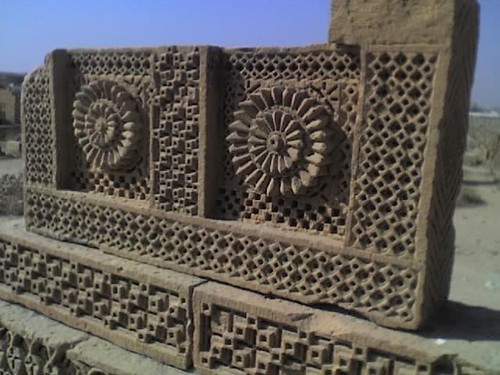
Chaukhandi (Urdu: چوکنڈی) tombs are situated 29 km east of Karachi on N-5 National Highway near Landhi Town in Pakistan. style of architecture is typical only to the region of Sindh, and unique in that it is found nowhere else in the Islamic world. Generally, the elements are attributed to Jokhio (also spelt Jokhiya) also known as the family graveyard of Jokhio tribe, some people of Baluch tribe also buried were built between the 15th and 18th centuries.

in Sindh and Baluchistan, is unique with their orientation from south to north. These graves are constructed in buff sandstone. Their carved decoration presents exquisite craftsmanship. These graves are constructed either as single graves or as groups of up to eight graves raised on a common platform.
Their primary sarcophagus has six vertical slabs, with two long slabs standing on each side of the grave covering the length of the body and the remaining two vertical slabs covering the head and foot side. These six slabs are covered by a second sarcophagus consisting of six more vertical slabs similar but in size giving the grave a pyramid shape. This upper (second sarcophagus) is further covered with four or five horizontal slabs and the topmost (third) sarcophagus is set vertically with its northern end carved into a knob known as a crown or a turban.

Hinidan by Major M. A. Tighe, Political Agent in southern Baluchistan. J. P. Vogel was the first to investigate this and other cemeteries – including Karpasan (a plateau south of Hinidan), Gundar (a village near Dinga, south of Hinidan), and Manghopir and he drew attention to another cemetery discovered by Captain Showers, Political Agent in Kalat, lying between the Hub River and Sonmiani. Vogel recognized that the tombs were Islamic, as indicated by the use of the Arabic script and the alignment of the monuments. Jokhia or Jokhiya (Urdu:جوکھيو) are said to be the descendant of the Samma (tribe). Chaukhandi cemetery, consisting of names or Quranic Verse. Some of the Jams who were named were said to belong to the Jokhio tribe still resident in the area.and the 1st raitar Mr, Ali Muhammad Jokhio of Jokhio History.

1917, H. D. Baskerville discovered a similar cemetery in the vicinity of the village of Chaukhandi, near Karachi. Baskerville's published report raised the question of above-ground burial – but he dismissed this possibility, describing a careful investigation of one of the stone chambers in the cemetery, which had not contained any remains. A number of tomb inscriptions were found at the Chaukhandi cemetery, consisting of names and/or sayings from the Quran. Some of the Jams who are named were said to belong to the Jokhiya tribe still resident in the vicinity.

Henry Cousens devoted a chapter of his book on the antiquities of Sindh to 'Baluch tombs. He studied tombs in Jarak (now spelt Jerruck), Sonda and Kharkharo, which were also of the same type. Referring to the studies by G. E. L. Carter, he noted that more than twenty such cemeteries had in the meantime been identified, and he rejected the theory regarding above ground burial, due to the frequent occurrence of arcade-like perforations in the lower casket. Cousens was the first to draw comparisons with other architectural monuments in Sindh, and he refers to similarities between the decoration of a tomb in Sonda and the tombs of Mian Ghuam Shah Kalhoro (Shah Wardi Khan) (d. 1772) in Hyderabad and The tomb of the Samma king, Jam Nizamuddin II (reigned 1461–1509), is an impressive square structure built of sandstone and decorated with floral and geometric medallions. Similar to this is the mausoleum Isa Khan Tarkhan the Younger (d. 1644) in the necropolis on Makli Hill. With regard to the covering of the tombs with chattris, he points to similar tombs in the same necropolis and to the tomb of Mir Masum in Sukkur.

the creation of Pakistan the Chaukhandi tombs, however, did not receive any attention from authorities until Dr. I. H. Qureshi a renowned historian and the then education minister (later Chancellor of Karachi University), drew the attention of the Department of Archeology and Museums to the Chaukhandi tombs, after receiving a letter from Zahid Hussain, Governor of State Bank of Pakistan citation needed.
Shaikh Khurshid Hasan mentioned that at first his department did not even realize that the tombs were protected under the Ancient Monuments Preservation Act, 1904. After a survey the Director General of the Department of Archeology and Museums called these a dolmen graveyard at Chaukhandi in the national press.

In the post-independence era the first serious studies were made by Mumtaz Hassan; he described Chaukhandi tombs as Baluch tombs. After that many articles were published in the national newspapers but the mystery as to their origin could not be solved.

his first paper based on epigraphical-cum-historical studies, Shaikh Khurshid Hasan observed that the Chaukhandi graveyard near Landhi was predominantly a graveyard of the Jokhio tribe, although some tombs of the Burfat and Sheikh tribes have also been found. In another article on Chaukhandi tombs in 1984 Shaikh Khurshid Hasan mainly dealt with the decorative elements of the stone carving. In the following years he also published on the gravestones and inscriptions. (1978) the German scholar Dr. Salome Zajadacz-Hastenrath published a book in German in which she mainly dealt with the stylistic evolution of Chaukhandi tombs. When comparing Chaukhandi tombs (namely tombs of particular types and forms thereof) among each other, a typological framework was established and consequently a relative chronology. By comparing this framework with dated structures, mainly of Makli Hill, but also of other sites, the study arrived at dates for the various stages of evolution of the Chaukhandi tombs which later developed, but which did, however, not replace preceding ones. Besides, Chaukhandi tombs strictly speaking, the study dealt also with individual topics like, for instance, with 'Form of the tombstones Riders, weapons, and other depictions on men's graves', 'Jewellery depictions on women's graves', articles which all show the richness of Chaukhandi funerary art. Further, the documentary part of the book includes a list of dated stonemasonry patterns on Chaukhandi tombs

the Italian Professor Gian Giuseppe Filippi visited Sindh and examined some prominent sites of Chaukhandi graveyards. He traced the Rajput influences in Chaukhandi graveyards. In this article he mentioned that it is well-known that many Munda warrior groups have family ties with the so-called Rajput tribes of Rajasthan and Gujarat. Even in this case, their warlike behavior and the confusing definition of the Rajput caste keeps open the ‘structure’ of Hinduism. Some among the Rajput tribes, namely the Jokhio , the Numeri, the Burfat and the Lashari emigrated from Kutch (Gujarat) and Rajputana towards the Sindh and Makran regions during the Samma Dynasty. All these tribes mentioned had close relations among each other including matrimonial ties, both within their own group as well as with the Baluch tribe of the Kalmatis. His hypothesis envisions a tribal Rajput origin in the utilization of not only the monolithic slabs and pedestals in the step-and-house-shaped Chaukhandi graves, but also in the naive decoration of some tombs which rather resemble a house facade like a human face as if drawn by a child. The decoration of the tombs (mostly with geometric motifs) is derived from wood sculpture.
On the type site of 'Chaukhandi', there is the tomb of Jam Murid bin Haji, which contains the word Chaukhandi, along with the name of the deceased. Shaikh Khurshid Hasan therefore, considered Chaukhandi to be the name of the place. Moreso, when Banerji visited the Chaukhandi graveyard in 1920, he referred it as "the little village Chaukhandi". According to Mumtaz Hassan, Chaw in Sindhi language means four and Khundi corner or pillar. Chaukhandi thus refers to the four pillars supporting the umbrella shaped dome over the tomb and would apply to all tombs having the same construction.[6] However, this argument does not find support because all the tombs covered with umbrella shaped domes or with a rectangular pavillion at Chaukhandi have more than four pillars or columns. Even [at] Mangophir canopy over similar graves has more than four pillars. As regards the view that Chaukhandi is the name of a place, Mumtaz Hassan feels that such a view derives strength from the fact that in the popular imagination the name Chaukhandi has come to be associated particularly with the tombs near Landhi. 'Baluch Tombs' – a name based on local traditions linking the tombs to various tribal groups, namely the Burfat, Kalamati, Jakhara and Jokhiya. The fact that the cemeteries lie in an area in which the Baluchis are either the only ethnic group or live alongside other tribes provides support for this description.
However, the area across which the cemeteries are spread is by no means identical with that of the Baluchis, but includes only a tiny fraction of it. For this reason, the term 'Baluch tombs' does not appear very accurate. It suggests the conclusion that this type of tomb is a peculiarity of the Baluchis and might be explained in some way through the common culture and history of the tribe as a whole – although there is no evidence of this.
 kalam valleY pics
 kalam valley
 kalam valley
 kalam valley
 swat valley near peshawer
 swat valley best landscape
 swat valley beautifull view
 swat valley towerest places
 swat valley pics
 murree tourist places
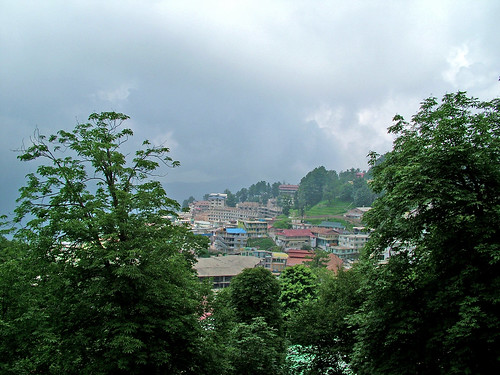 murree tourist places
 murree tourist places
 murree tourist places
 murree tourist places
 murree tourist places
 murree tourist places
 murree tourist places
 murree tourist places
 Boly wood actress mira on karachi air port
 Karachi Quaid-e-azam international airport out side front
 karachi historical musiam
 Tomb of Quaid-e- azam mouhammad ali jinah
 historical bilding in karachi
 shrine of abdulla shah gazi on clifton karachi
 beautifull historical bilding in karachi
 karachi historical and towerest atracations places
 Intery gate of abdulla shah gazi shrine
 karachi buildings autharity demolish the old bildings
 Karachi Laibrery historical building
 Karachi historical building and places
 Habib bank plaza in karachi
 KMC bilding in karachi
 Park towers shoping centre on main clifton
 KFC on clifton park towers
 Clifton parks pics
 clifton sea view pics
 clifton Benezir bhhoto park in side view
 Clifton karachi beach
 Clifton karachi beach
 Clifton karachi beach
 Clifton karachi beach beautifull view
 Clifton karachi pics